Real Estate Comps Free: Build a Comps Sheet for Any Address
Updated Nov 18, 2026
You can get real estate comps free from three places: the "Sold" filter on Zillow or Redfin, your county's property records, and a free comparative market analysis (CMA) from a local agent. A good comp is a closed sale from the last three to six months, within about half a mile, and within about 300 square feet of the home you're pricing. Put six to ten of those sales in one sheet, with a source link for every number, and you can price a home without paying for data.
The free sites give you the raw sales. They don't give you one sheet that lines those sales up side by side and shows where each number came from. That sheet is what turns a pile of listings into a price, and this guide shows you how to build it.
A comp, short for "comparable sale," is a recently sold home that is similar enough to yours that its price tells you something about your home's value. If you want the basics first, see what comps are and the columns to track. This page is about getting comps for free and turning them into a number.
Where can you find real estate comps for free?
The best free sources for comps are listing sites, county records and local agents, and each one has a catch. Here's what you get from each and what to watch for.
| Free source | What you get | The catch |
|---|---|---|
| Zillow or Redfin "Sold" filter | Recent sales on a map, with photos, beds, baths and square feet | Square feet and condition come from the listing, which can be wrong |
| County assessor or recorder records | The recorded sale price and date, lot size, year built | Some states don't make sale prices public |
| A free CMA from a local agent | Sales pulled from the MLS, the private database agents use | It comes with a sales pitch, and you don't pick the comps |
| Zestimate or Redfin Estimate | A single automated number | It's an estimate, not a sale, so don't use it as a comp |
On Zillow, set the listing-status filter at the top of the search from "For sale" to "Sold," then sort by newest. Redfin works the same way: choose "Sold" in the "For Sale" dropdown.
The county-records route has one big gap. In a non-disclosure state, only the buyer, the seller and their agents can see the exact sale price. Redfin lists Alaska, Idaho, Kansas, Louisiana, Mississippi, Missouri, Montana, New Mexico, Texas and Wyoming among them. If you're in one of those states, sale prices on free sites may be missing or estimated, and an agent's CMA is often the only reliable free source.
What columns should your comps sheet have?
A comps sheet needs enough columns to compare homes fairly and to check every number later. These are worth keeping, and here's why each one earns its spot:
- The street address, so you can find the sale again.
- Sale price and sale date. Use closed sales only, because a list price is just what the seller hoped for.
- List price, if you can get it. The gap between list and sale price shows how hot the street is.
- Distance from your home. Anything past half a mile needs a reason to stay.
- Beds, baths and living square feet. These are the core of "similar."
- Year built and lot size. A 1960s house and a 2015 house on the same street aren't the same product.
- Price per square foot: the sale price divided by living square feet. This is the number you'll compare.
- Condition notes, such as a renovated kitchen, an original roof or a pool.
- A source link for the page each number came from.
People skip the source column most often, and it matters most. Zillow, Redfin and the county often disagree on square footage, for example when one counts a finished basement and another doesn't. If you don't know where a number came from, you can't tell which one to trust when two sources clash.
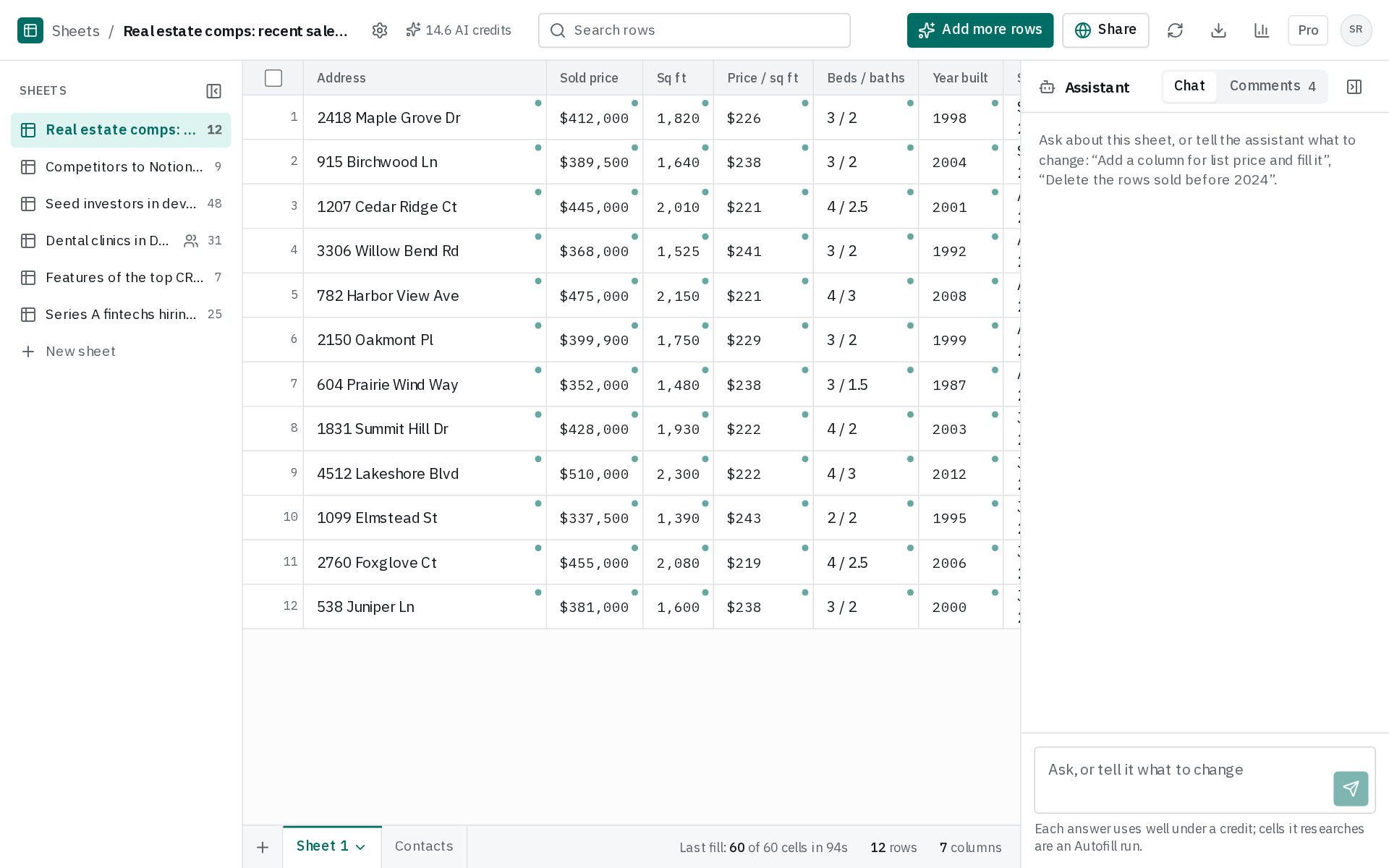
How do you build a free comps sheet, step by step?
You can build a free comps sheet in six steps: record your own home's facts, set your filters, pull more candidates than you need, confirm each sale price, work out price per square foot, then adjust for the big differences. The order matters, because deciding your rules before you see prices keeps you honest.
1. Write down your own home's facts first
Put the subject home (the one you're pricing) in the top row: beds, baths, living square feet, lot size, year built and condition. Use the county record for square feet if you can, since that's what an appraiser will start from. You can't judge "similar" until you've pinned down what you're comparing against.
2. Set your filters before you start looking
Zillow's guide to comps suggests limiting your search to a quarter to half a mile from your home, including homes that sold within the past three to six months, and staying within about 300 square feet of your home's size. Write these limits down before you search. Once you've seen the prices, it's tempting to keep the high sales and quietly drop the low ones.
3. Pull six to ten candidates, not three
You need at least three good comps, but some candidates won't survive a second look. One turns out to be a flip, another a short sale, another has a pool yours doesn't. Start with more than you need. If the area is quiet, widen the time window before you widen the distance, because a sale across a major road or in another school zone can be a different market.
4. Confirm every sale price with a second source
Check each sale price against a second source, ideally the county record. If the two don't match, note it and keep both source links. Doing this by hand is slow: six to ten addresses across two or three sites is a lot of tab-switching and copy-paste. It's also the step most worth getting right.
5. Work out price per square foot and look at the range
Divide each sale price by its living square feet, then look at the middle of the range, not the average. One odd sale can drag an average a long way. Here's an illustration with made-up numbers: say you're pricing an 1,800-square-foot three-bed, and your three best comps sold at $195, $200 and $202 per square foot. The middle value is $200, so your starting point is 1,800 × $200 = $360,000.
6. Adjust for the big differences
Now go row by row. If a comp has a renovated kitchen and yours doesn't, your home is probably worth less than its price per square foot suggests. If yours has a garage the comp lacks, adjust up. How much each feature is worth is a judgment call, and it's the part an appraiser or experienced agent does best. Your sheet gives you a range you can defend. It doesn't replace an appraisal.
What mistakes throw off free comps?
The most common mistakes are treating an estimate as a sale, mixing seasons, counting homes that haven't sold, and trusting one site's square footage.
Using the Zestimate as a comp. Zillow says the nationwide median error for the Zestimate is 1.77% for homes on the market and 7.20% for off-market homes (checked November 2026). On a $360,000 home, 7.2% is about $26,000, and half of off-market homes miss by more than that. Use the estimate as a sanity check, never as a row in your sheet.
Mixing up seasons. Prices move during the year. ATTOM's 2025 analysis of more than 47 million sales found a seller premium of 9.5% in May and 6.4% in November. If all your comps sold in spring and you're listing in late fall, lean toward the low end of your range.
Counting active listings. A home that's listed but hasn't sold only shows what someone is asking. Keep active listings in a separate tab as "the competition," not as comps.
Trusting one source's square footage. If you can't explain a gap between two sources, leave that comp out.
When are free comps not enough?
Free comps are enough for a quick gut check on one house, and they turn into a chore when you need them every week. Think of an agent prepping for listing appointments, an investor screening several properties, or anyone who wants every number traced to a source without opening thirty tabs. At that point you're paying with your time, and steps 3 and 4 are where most of it goes. For income properties, where you compare price per unit or per square foot of building, see pulling commercial sales comps into a spreadsheet.
Doing this in Autofill
Autofill builds the comps sheet and does the row-by-row research that eats your afternoon. You describe what you need in one sentence (for example, "comps for a three-bed, two-bath house near my address, sold in the last six months"), and it proposes columns like address, sale price, sale date, beds/baths and square feet. It can find the sales themselves, not only fill in facts about rows you already have, and it researches each row on the web so you can see where every number came from. When you're done, you can share the sheet with a read-only link or download it as CSV or Excel.
The trade is simple: the free route costs hours of copy-paste per comp set, while Autofill costs credits and gives you that time back. You start with free credits, so you can try it on one address before deciding it's worth paying for.
It doesn't do everything. Autofill has no MLS access, so in non-disclosure states it can't find sale prices that were never made public. It also won't make the judgment calls in step 6 for you. Treat every filled cell the way you'd treat a free site: check the source before you rely on the number. If you're new to building sheets from a prompt, the AI table generator guide explains how the one-sentence approach works.
Questions
How do I find comparable home sales for free?
Filter Zillow or Redfin to "Sold," limit the search to homes within half a mile that sold in the last three to six months, and confirm each sale price in your county's property records. In a non-disclosure state, ask a local agent for a free CMA, since sale prices aren't in the public record there.
How much would a real estate agent make on a $300,000 house?
There's no fixed answer, because commissions are negotiable and the agent shares the fee with their brokerage. As an illustration, a 2.5% commission on $300,000 is $7,500 before the brokerage takes its split, so the agent keeps less than that.
What is the 3-3-3 rule in real estate?
It's an informal rule that people use in a few different ways. One common version says to save three months of living expenses, keep three months of mortgage reserves, and compare at least three similar homes before you make an offer. That last part matches the minimum number of comps this guide recommends.